
Tuesday, November 13, 2012
Death Penalty Demo in Zürich
On 13th October – in glorious sunshine in the Hirschenplatz – we held our demonstration against the Death Penalty, in the course of which we collected signatures for the abolition of the Death penalty in Japan, and also in support of the forthcoming UN resolution on Burma.
The action was a great success, and we were able to send off 210 and 170 signatures respectively.
Passers-by were also very intrigued by our Info-Game, in which we told people about various cases of individuals on Death Row as well as some who had already been executed. People were then invited to decide which countries these had happened in. Many were surprised at just how many countries still retained
the Death Penalty, and for which crimes.
The Cup-Cakes we handed out were delicious and also very successful (Grateful thanks to Melanie and Rebecca!). We hope to be able to hold a similar demonstration next year. Many thanks to all who supported us and took part on the day.

Saturday, November 10, 2012
Event: the future of human rights in Egypt
The event will be in German, that's why this post is in German as well :-)
Die Zukunft der Menschenrechte in Aegypten
Die englischsprachige Gruppe von Amnesty International Zürich plant eine Veranstaltung zu der Zukunft der Menschenrechte im Arabischen Raum am Beispiel von Aegypten.
Dazu haben wir die Amnesty Expertin für Aegypten eingeladen, die über die aktuelle Situation der Menschrechte in Aegypten berichten wird. Ausserdem wird sie auch auf das grosse Problem der sexuellen Belästigung eingehen.
Bitte anmelden bei: Chrispieh(at)msn.com
Sprache: Deutsch
Wann: 19.11.2012, 19:00
Wo: Volkhaus, Zimmer 23
Stauffacherstrasse 60
8004 Zürich
Stauffacherstrasse 60
8004 Zürich
Falls mehr Personen erscheinen als geplant, findet die Veranstaltung im Volkshaus statt, darüber wird rechtzeitig informiert werden.
Monday, October 1, 2012
Action to world day against death penalty
When: Saturday October 13th
Where: Hirschenplatz, Zürich
What time: 10:00 until 17:00
Together with the China group, we are organizing an action against death penalty.
Visit our booth at Hirschenplatz to sign a petition against death penalty, to eat a yellow cupcake, to be informed on death penalty, to play our anti-death-penalty game, to pick up a yellow Amnesty balloon or just to say hello :-)
Where: Hirschenplatz, Zürich
What time: 10:00 until 17:00
Together with the China group, we are organizing an action against death penalty.
Visit our booth at Hirschenplatz to sign a petition against death penalty, to eat a yellow cupcake, to be informed on death penalty, to play our anti-death-penalty game, to pick up a yellow Amnesty balloon or just to say hello :-)
Saturday, April 28, 2012
The Death Penalty in the USA
Amnesty campaigns tirelessly for the abolition of the Death Penalty, which denies those most basic of Human Rights : the right to life, and not to be tortured or suffer degrading treatment. But in the US, alone among the democratic countries of the free West, several states continue to apply the Death Penalty, and it is increasingly apparent that an unacceptable degree of racial discrimination is at work here.
This issue hit the international headlines in September 2011, when Death Row veteran Troy Davis, who had for over twenty years protested his innocence, was executed by lethal injection, despite a million petitioners world-wide urging clemency from the Georgia authorities.
Many studies have shown that the US Death Penalty discriminates against black people. Black defendants are less likely to be well represented by competent lawyers, evidence is sometimes mislaid, and so on. While blacks and whites are murdered in roughly equal numbers, the killers of white people are six times more likely to be executed, with 77% being put to death for killing a white, but only 15% for killing blacks (http://www.amnestyusa.org/our-work/issues/death-penalty/us-death-penalty-facts/death-penalty-and-race).
The most recent case Amnesty has campaigned for was that of Linda Carty, a UK citizen by virtue of her birth in St Kitts. She was accused of murder in Texas – and defended by a lawyer who had already seen twenty of his clients doomed to Death Row. Her trial was seriously flawed, and she still faces execution despite this inadequate legal representation. There are now many campaigns for her reprieve, led strongly by Amnesty International.
This is just one case among many that AI urges you to support. Later this year the Zurich Amnesty group hopes to stage an anti-Death Penalty Action.We’ll let you know. Meanwhile there are petitions on the Amnesty website that would welcome your response (http://takeaction.amnestyusa.org/siteapps/advocacy/ActionItem.aspx?c=6oJCLQPAJiJUG&b=6645049&aid=14230)
The Death Penalty has no place in any civilised society. The contribution of your signature will make a real difference.
Janice Davis, Vilters.
Monday, December 26, 2011
A Very Special Christmas Present
by Janice Davis
I volunteered to be the one responsible in our Zürich English-speaking group of Amnesty International for the case of Chen Zhen Ping. This is a Chinese lady who is a supporter of the Falun Gong spiritual movement, and as a result of which finds herself imprisoned and subjected to torture and degrading treatment.
She has been sentenced to eight years’ imprisonment for “using a heretical organisation to subvert the law”. Amnesty understands that she has been forcibly injected with drugs and subjected to regular beatings.
Falun Gong is a belief system that has been banned by the Chinese authorities, and its members face regular intimidation and persecution for their beliefs. Chen Zhen Ping is currently being held at Women’s No. 5 Prison, Henan Province, where an estimated 200 Falun Gong practitioners are held. Other prisoners have confirmed that the Falun Gong prisoners are daily subjected to broadcasts denouncing their beliefs and to high-pitched music unless they renounce their beliefs.
Amnesty is concerned that Chen Zhen Ping is still being subjected to torture and that her health is at serious risk.
We sent several letters, to the prison where she is held, and to various government officials, urging hat Chen Zhen Ping be released immediately and unconditionally; and that she should have access to legal representation; and should not be subjected to any mis-treatment.
And we also sent a card to her daughter, who now lives in Finland and is active in support of her mother. We sent our good wishes for her Mother and also all the family.
So it was a very special surprise to receive a parcel from Finland on Christmas Eve. It was addressed to Amnesty International Switzerland, and somehow my local Post Office thought it should be delivered to me. I was bemused : who could be writing to me from Finland ?
It was a box of chocolates from the daughter of Chen Zhen Ping, together with a card saying : To Switzerland Amnesty. Merry Christmas. Happy New Year. Thank you – help me and my Mom Chen Zhen Ping. Thank you very much !!!
So lovely. I will take the choccies to our next meeting in Zürich. And we will all enjoy.
Meanwhile – please all be aware that however little we think we are doing – just sending a letter, a card – it all makes a difference. I just did some school talks at the Kantonalschule in Sargans, and we ended up sending off eighty letters on behalf of Jabbar Sevelan in Azerbaijan. Bring it on !
She has been sentenced to eight years’ imprisonment for “using a heretical organisation to subvert the law”. Amnesty understands that she has been forcibly injected with drugs and subjected to regular beatings.
Falun Gong is a belief system that has been banned by the Chinese authorities, and its members face regular intimidation and persecution for their beliefs. Chen Zhen Ping is currently being held at Women’s No. 5 Prison, Henan Province, where an estimated 200 Falun Gong practitioners are held. Other prisoners have confirmed that the Falun Gong prisoners are daily subjected to broadcasts denouncing their beliefs and to high-pitched music unless they renounce their beliefs.
Amnesty is concerned that Chen Zhen Ping is still being subjected to torture and that her health is at serious risk.
We sent several letters, to the prison where she is held, and to various government officials, urging hat Chen Zhen Ping be released immediately and unconditionally; and that she should have access to legal representation; and should not be subjected to any mis-treatment.
And we also sent a card to her daughter, who now lives in Finland and is active in support of her mother. We sent our good wishes for her Mother and also all the family.
So it was a very special surprise to receive a parcel from Finland on Christmas Eve. It was addressed to Amnesty International Switzerland, and somehow my local Post Office thought it should be delivered to me. I was bemused : who could be writing to me from Finland ?
It was a box of chocolates from the daughter of Chen Zhen Ping, together with a card saying : To Switzerland Amnesty. Merry Christmas. Happy New Year. Thank you – help me and my Mom Chen Zhen Ping. Thank you very much !!!
So lovely. I will take the choccies to our next meeting in Zürich. And we will all enjoy.
Meanwhile – please all be aware that however little we think we are doing – just sending a letter, a card – it all makes a difference. I just did some school talks at the Kantonalschule in Sargans, and we ended up sending off eighty letters on behalf of Jabbar Sevelan in Azerbaijan. Bring it on !
Sunday, August 21, 2011
Aleksei Sokolov Released!
Good News Story
A court in Krasnoyarsk decided to release Aleksei Sokolov on parole on 27 July 2011. He was arrested in May 2009 and sentenced for theft and robbery a year later, on charges that many believed to have been fabricated in response to his human rights work in defence of prisoners' rights. He was allowed to leave the prison colony shortly after the July court hearing and is now back home with his family in Yekaterinburg. Alexei Sokolov had two previous parole applications turned down on the flimsiest of pretexts earlier this year.
When Amnesty International spoke to Aleksei Sokolov he said he was relieved to be able to go back to his wife and children. He thanked Amnesty International and its members as well as the many other human rights organizations that have supported him over the last two years.
Background: Human rights defender Aleksei Sokolov, head and founder of the organization Pravovaia Osnova in Ekarerinburg, was detained on 13 May 2009 and later charged with theft. He was briefly released on 31 July 2009 but detained the same day and charged with robbery in connection with a different incident. He has been kept in detention ever since, including at times without a judicial decision legalizing his prolonged pre-trial detention. On 14 May 2010 he was found guilty of theft and robbery and sentenced to five years imprisonment. Upon appeal his sentence was reduced to three years.
Amnesty International campaigned for his release, considering him a prisoner of conscience detained solely for the peaceful exercise of his right to freedom of expression in the course of his lawful human rights activities in Russia. The Amnesty International Zurich English Group has been working on his case since 2010.
Thank you to everyone who was involved!
Tuesday, May 10, 2011
Amnesty’s 50th Anniversary
 May 2011, supporters of Amnesty International throughout the world will be celebrating 50 years of Human Rights Action, on behalf of those who suffer injustice and abuse. Many official events are planned nationally and locally, and Amnesty has launched a series of historic posters for display, including designs by Picasso and Miro.
AI Schweiz will be no exception, and a special event is planned for Saturday 14th May in the Paradeplatz Zurich.
The Zurich AI groups want to stage a really joyful action to celebrate all the work that ordinary Amnesty members have been doing since 1961. They are inviting everyone to join them for the day in the Paradeplatz, which they intend to rename – especially for the occasion – “Human Rights Square” !
To celebrate AI Schweiz as we all know it, there will be something for everybody. Placards will tell you details of the 30 Articles of the Universal Declaration of Human Rights. You can find out about work on urgent actions and individual cases. Visitors can write a card, supporting our anniversary message, and learn about how Amnesty really does get results. Students from Zurich’s Art College are creating an installation depicting the reality of Human Rights, in a novel and entertaining way. And there will be plenty for the children to do. They can take part in a huge memory game about Human Rights – and get an AI balloon to play with.
This is an unmissable opportunity for all of Zurich to:
• Celebrate 50 years of Amnesty
• Learn more about what Amnesty does
• Find out about Amnesty’s success stories
• And have a lot of fun !
Sometimes it feels difficult to be light-hearted about Amnesty’s work. The reality is often depressing, shameful, frustrating. But Amnesty campaigns do work ! Prisoners are released and reunited with their families ; death sentences are repealed ; the “disappeared” are found again. There is a lot to celebrate and tell the world about. So come and join in the celebration on 14th May!
Monday, May 9, 2011
Anthony Graves speaking in Zürich
Anthony Graves will be telling us his story of spending 18 years behind bars, including 12 on death row, for murders that prosecutors now say he didn't commit.
Anthony Graves thus became the 138th Death row inmate, wrongfully accused, and exonerated since 1973 - an interesting reflection of the justice system. Just months after his release, Anthony Graves comes to Switzerland to report on the death penalty and life on death row.
Date and time:
12 May · 12:30 - 14:00
Location:
Universität Zürich - Ko2-F-174
Rämistrasse 71
Anthony Graves thus became the 138th Death row inmate, wrongfully accused, and exonerated since 1973 - an interesting reflection of the justice system. Just months after his release, Anthony Graves comes to Switzerland to report on the death penalty and life on death row.
Date and time:
12 May · 12:30 - 14:00
Location:
Universität Zürich - Ko2-F-174
Rämistrasse 71
Saturday, February 19, 2011
Nothilfe / Emergency Assistance Campaign
Amnesty International and several other groups launched a campaign on 3 February 2011 to criticize the "emergency assistance" (or "Nothilfe" in German) system in Switzerland for asylum seekers whose applications have been rejected. Amnesty International believes that the emergency assistance system violates the human rights and human dignity of failed asylum seekers.
The main objectives of the campaign are as follows:
- to force the cantons to review the emergency assistance program
- to ensure that particularly vulnerable persons, such as the traumatized, ill, pregnant women, unaccompanied minors, families with children and unmarried women, won't fall within the emergency assistance system and could instead benefit from ordinary social assistance
- to guarantee that children have the right to go to school and receive access to proper nutrition
On 7 February, a "Container Action" was organized in Zurich and which ran for one full week, until 13 February. The container symbolized the loneliness and isolation experienced by asylum seekers. It also demonstrated the inadequate space that asylum seekers live in, as well as the lack of any privacy. The container had photos and information about the emergency assistance system. Members of the Amnesty International English Speaking Group in Zurich participated in the action, collected signatures for a petition and distributed "Nothilfe" sets.
Below are a few photos from the container action in Zurich.


Tuesday, December 14, 2010
End the segregation of Romani children in Slovakia’s schools

The Amnesty International Zurich English Group is taking action on behalf of the thousands of Romani children across Slovakia who remain trapped in substandard education as a result of widespread discrimination and a school system that keeps failing them.
What we did
We sent a letter to the Slovak authorities, urging them to take the necessary measures to respect, protect and fulfil the right to education free from discrimination for all children and to end racial segregation in education.
We also signed colourful keys, which we have sent to the Slovak authorities. These keys symbolize the following:
- They remind the government that it holds the key to allow the Roma in Slovakia full participation in Slovak and European society.
- We want them to unlock and open up the doors in situations in which Romani children from kindergarten onwards are sometimes locked into separate classrooms, corridors or buildings, separated even at lunchtimes, to prevent them from mixing with non-Romani children.
Background
Segregation of Romani children takes various forms: in several districts, Romani children attend ethnically segregated mainstream schools and classes that often operate reduced curriculums.
In regions with large Romani populations at least three out of four children in special schools designed for pupils with "mild mental disabilities" are Roma; across the country as a whole, Roma represent 85 per cent of children attending special classes. Yet, Roma comprise less than 10 per cent of Slovakia’s total population.
Slovakia’s mainstream elementary-school system is ill-equipped and education professionals are often unwilling to provide the additional support that pupils from different ethnic and social backgrounds often need.
For many Roma, Slovak is not a first language. Cultural differences and high levels of poverty among Roma mean that they often need additional language, pre-school or classroom assistance. When these needs are not met, many Romani children fall behind and are transferred out of mainstream education – either to special classes in mainstream schools or to dedicated special schools.
Romani children who are placed at special schools or classes have very little chance of being reintegrated in mainstream education. Additionally, when pupils finish elementary school under a special curriculum, they receive lower graded certificates, which restrict them to attending special-secondary school. This involves a programme of two or three years’ vocational training to become, for example, butchers, bricklayers, shoemakers, domestic workers or gardeners.
Discrimination and segregation in Slovak schools exclude Roma from full participation in society and lock them into a cycle of poverty and marginalization.
Slovakia’s 2008 Schools Act bans all forms of discrimination, particularly segregation. But it fails to clearly define segregation, or include robust guidelines and measures to help education authorities identify and monitor segregation and enforce desegregation. Effective measures to implement the ban have yet to be put in place.
The new government’s recently stated commitment to eliminate segregated schooling of Roma, included in the coalition government’s programme adopted in August 2010 is, however, a welcome development.
The Slovak government has much to do to end the segregation that has an impact on a large part of the country’s population. Segregation in education means a life-long stigma for children whose future chances are brutally limited. The choices that the government makes now will affect the lives of thousands of Romani children. The government holds the key to allow the Roma in Slovakia full participation in Slovak and European society.
Friday, November 5, 2010
AI in Pub Treasure Hunt
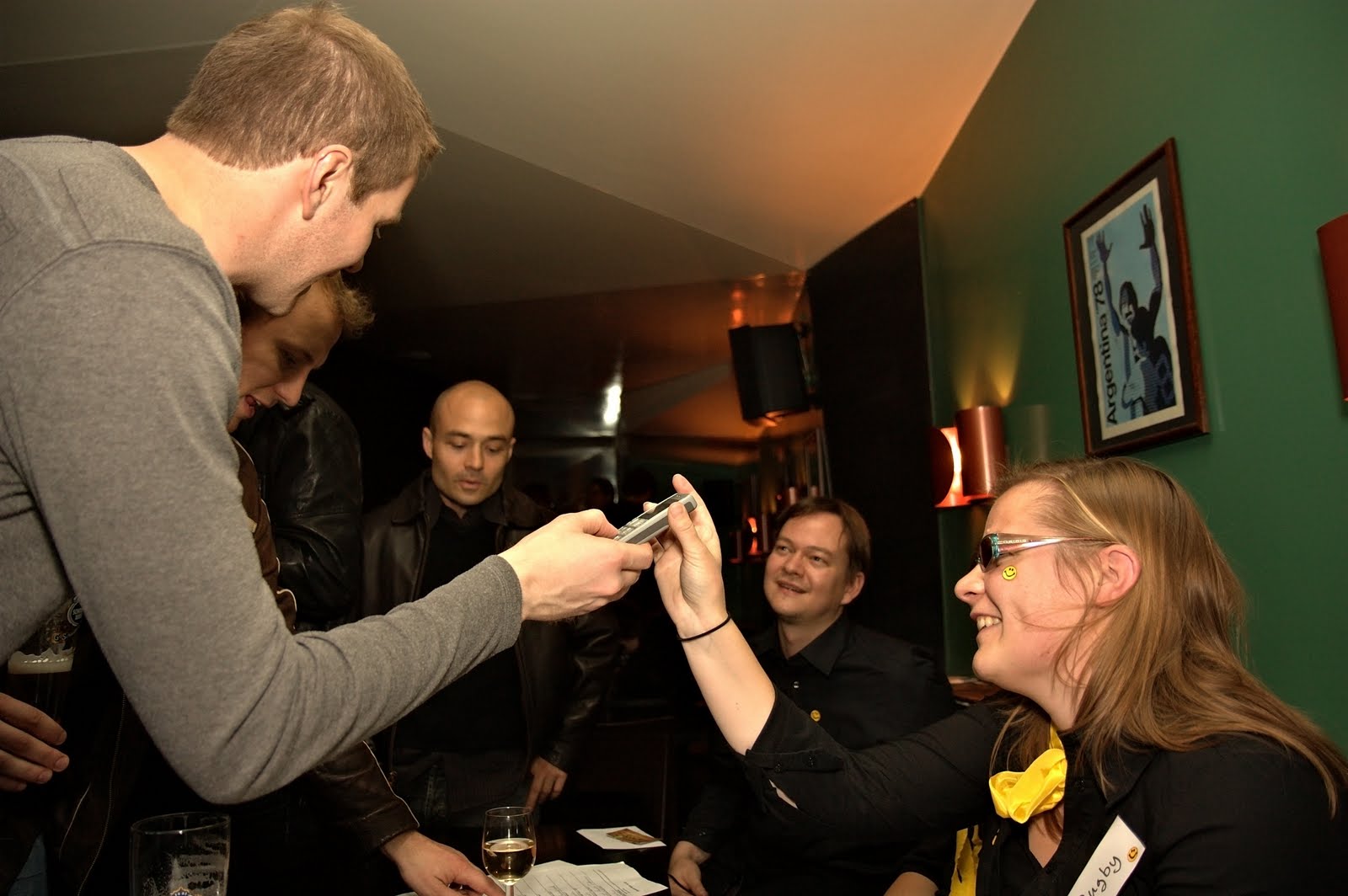
Friday October 22 Hanneke, Marz, Adrian, Richard and Annemiek dressed up in black, put on sunglasses and covered themselves with smileys (to have a hint of AI color). Then, they made themselves comfortable in bar Rossi sitting between the soccer posters and AI flyers.
As part of the Zürich Pub Treasure Hunt about 120 people passed by and received the following questions (among others):
1. What does 48626 744487 say? Name 2 of these you are using now.
2. Why would you contact Marz?
Do you know the answers? If not, scroll down.
Almost all of the participants successfully spent some time thinking about AI or related subjects, answered the questions right and some took the flyers home.


1. Human Rights (on your phone), e.g:
- Freedom to move
- Right to public assembly
- Right to play (/rest)
2. To have more information about the Englich AI Zürich Group
As part of the Zürich Pub Treasure Hunt about 120 people passed by and received the following questions (among others):
1. What does 48626 744487 say? Name 2 of these you are using now.
2. Why would you contact Marz?
Do you know the answers? If not, scroll down.
Almost all of the participants successfully spent some time thinking about AI or related subjects, answered the questions right and some took the flyers home.



1. Human Rights (on your phone), e.g:
- Freedom to move
- Right to public assembly
- Right to play (/rest)
2. To have more information about the Englich AI Zürich Group
Wednesday, September 29, 2010
Update on Imprisoned Russian Human Rights Defender
On September 9, 2010, Aleksei Sokolov was transferred from a remand centre in Novosibirsk to Krasnovarsk Region where he is due to serve his sentence. His family does not know yet which prison colony in Krasnovarsk Region he was sent to.
Until Amnesty International knows which prison colony he has been sent to, it is not possible to send Aleksei Sokolov letters of support. However, our support is very important for Aleksei Sokolov. His wife told an Amnesty International activist:
‘Every member of Amnesty International is a friend to Aleksei. He could only hold on during this year and a half thanks to your words of support, your letters, cards and your actions.’
As Aleksei Sokolov is at imminent risk of torture and other ill-treatment, Amnesty International Zurich English Speaking group is continuing to write to the authorities, asking them to bring about the following:
- to ensure Aleksei Sokolov's second appeal is given a full and fair hearing
- to ensure he is not subjected to torture or other forms of ill-treatment while in custody
- to ensure that he is given daily exercise and nutritious food, and is given his correspondence while in custody
- to transfer him to a detention centre closer to his home in the city of Yekateringburg where it is easier for his family and legal team to maintain close contact with him
- to conduct a prompt, thorough and impartial investigation into allegations that he has been beaten by prison guards while being held in a remand centre in Novosibirsk, Western Siberia, and to bring those responsible to justice
Amnesty International continues to believe that Aleksei Sokolov is a prisoner of conscience detained solely for the peaceful exercise of his right to freedom of expression in the course of his lawful human rights activities in Russia. He should be allowed to pursue his lawful activities as a human rights defender in Russia without fear of repercussions.
Wednesday, September 8, 2010
UPDATE: Russian human rights defender beaten
Russian human rights defender Aleksei Sokolov is at risk of torture or other ill-treatment. He is currently held in a remand centre in Novosibirsk, Western Siberia, where he has allegedly been beaten by prison guards. In the coming days he is due to be transferred to a prison in the Krasnoyarsk region of Siberia, thousands of kilometres from his home. He remains at risk of further torture and ill-treatment.
Aleksei Sokolov, the head of a Russian human rights organization, was sentenced to five years' imprisonment in May 2010 for theft and robbery. His sentence, which was imposed after a trial held with several reported violations of fair trial standards, was reduced to three years' imprisonment on appeal. His lawyers are planning a further appeal. Amnesty International is concerned that Aleksei Sokolov may be a prisoner of conscience, targeted for his human rights work.
According to his lawyers, Aleksei Sokolov has been ordered to serve his sentence in Krasnoyarsk, more than 2,000 kilometres from the city of Yekaterinburg, where he lives and where he has been held until 25 August. On 26 August, he was transferred to the FGU IZ-54/1 remand centre in Novosibirsk, located between Yekaterinburg and Krasnoyarsk. Local sources have reported to Amnesty International that shortly after his arrival in Novosibirsk, he was beaten up by prison guards and that he has also been placed in solitary confinement for several hours. Amnesty International is concerned that Aleksei Sokolov could face similar treatment in Krasnoyarsk.
Amnesty International is concerned that sending Aleksei Sokolov to serve his sentence far from his home does not comply with international human rights standards requiring that prisoners should serve their sentence close to their home whenever possible, in particular to allow for family visits. Aleksei Sokolov’s transfer to Krasnoyarsk prison colony also makes communication with his lawyers more difficult, which might violate his right to receive a fair hearing of his intended second appeal. The decision to send him to Krasnoyarsk was allegedly given in a special directive from the Russian Prison Service received by the prison authorities in Yekaterinburg shortly after his sentence was reduced on appeal.
For further information, please see: Russian Federation: Further information: Russian human rights defender beaten: Aleksei Sokolov (EUR 46/031/2010), September 2010.
Thursday, August 26, 2010
Russian Human Rights Activist Aleksei Sokolov
Amnesty International is concerned that Aleksei Sokolov may be a prisoner of conscience detained solely for the peaceful exercise of his right to freedom of expression in the course of his lawful human rights activities.
Demand a Fair Appeal for Aleksei Sokolov
Human Rights Activist Aleksei Sokolov was sentenced on 13 May 2010, to serve five years in a high security prison colony for theft allegedly committed in 2001 and for robbery allegedly committed in 2004. The court found him not guilty in another robbery he was charged with.
His appeal was to be heard on 16 July 2010 but the Sverdlovsk Regional Court postponed the hearing until 18 August 2010. The official reason for postponing the hearing was that allegedly, Aleksei Sokolov’s co-defendents did not have lawyers to represent them. However, his defence team think that the real reason behind it could be the international and media attention on the case.
According to Aleksei Sokolov’s lawyers, the Bogdanovich town court in the Sverdlovsk region of Russia based its verdict solely on the statements of the co-accused in the case who are already serving prison sentences for other crimes. During the trial, the defence lawyers pointed out that these statements often contradicted each other as well as earlier ‘confesions’ of the co-accused. One of his lawyers said that while victims of the crimes identified the other defendants in the case as possible perpetrators of the crime, none of them identified Aleksei Sokolov. The court nevertheless considered there to be enough evidence to convict Aleksei Sokolov.
Aleksei Sokolov’s lawyer also reported a number of violations of criminal procedure in the handling of the case throughout the pre-trial and trial stage.
Risk of Torture and other Ill-Treatment
Torture and ill-treatment in places of detention in Russia is a serious issue of concern to Amnesty International. Aleksei Sokolov is one of those human rights activists who campaigned against and exposed cases of torture and other ill-treatment in prison colonies and by the police in Sverdlovsk Region.
Sources close to Aleksei Sokolov have told Amnesty International that his detention conditions have deteriorated. According to reports, his diet is very meagre and, allegedly, the food that his family sends to him is being confiscated or chopped up so much that it becomes inedible. These sources also report that the length of his walks has been shortened to half an hour each day.
Human Rights Activities
Aleksei Sokolov is a founder and the head of the Russian human rights organization Pravovaia Osnova (Legal Base) which campaigns against torture and other ill-treatment of detainees in the Russian Federation. The work of Legal Base brought about several investigations against law enforcement officers on allegations including the use of torture to coerce suspects to "confess."
Aleksei Sokolov became prominent after he publicized and distributed a film about torture and other ill-treatment in a temporary holding centre in prison colony IK-2 in Yekaterinburg. The film received wide coverage, both in Russia and internationally, and led to the closure of the temporary holding centre.
He was also investigating possible corruption in some law-enforcement agencies in Yekaterinburg: some officials, according to his findings, had helped to cover up impunity in the temporary holding centre in Yekaterinburg.
In 2008 Aleksei Sokolov was appointed a member of the Public Commission for the control of places of detention and conducted a series of visits to detention facilities in this capacity. He got suspended from this position following his detention in May 2009.
In 2008 he learned that several prisoners were being pressured into claiming falsely that he had been involved in crimes including the robbery in 2004, on suspicion of which he has been in custody since 13 May 2009. Investigations into the theft in 2001 and the robbery in 2004 had been closed several times because the perpetrators could not be identified, but were re-opened shortly before Aleksei Sokolov’s arrest.
When in July 2009 the Sverdlovsk Regional Court ordered that he should be discharged until his trial, instead of being released, the police told him that he was then arrested on suspicion of another robbery committed in 2004. Later prosecution added charges of theft of metal pipes from a factory in 2001.
Shortly after his detention, police allegedly threatened to torture him because of his work in defence of human rights.
For further information, please see:
Russian Federation: Demand a Fair Appeal for Aleksei Sokolov: Further Information (Index EUR 46/016/2010), May 2010; Russian Human Rights Defender Jailed for Five Years, May 2010; Russia Must Stop Persecution of Rights Activists, December 2009.
Monday, August 9, 2010
Eritreans at risk of forcible return from Libya after detention centre disturbances
The letter most recently sent by our group was based on this news item, published at www.amnesty.org:
"Amnesty International has urged the Libyan authorities not to forcibly return around 200 Eritreans held in detention amid allegations that several prisoners were beaten by security officials after an escape attempt last week.
The Eritreans, who include refugees and asylum seekers as well as migrants, are currently held at al-Birak, a detention centre in Sabha, where they are reported to be subject to beatings and other ill-treatment."
The Eritreans, who include refugees and asylum seekers as well as migrants, are currently held at al-Birak, a detention centre in Sabha, where they are reported to be subject to beatings and other ill-treatment."
Tuesday, July 20, 2010
Human Rights Defender Emadeddin Baghi
The Amnesty International Zurich English Group is campaigning on behalf of Iranian human rights defender and journalist Emadeddin Baghi. Amnesty International is calling on the Iranian authorities to grant him a fair trial and reminds the authorities that, as a state party to the International Covenant on Civil and Political Rights, Iran is obliged to uphold Baghi’s right to freedom of expression and speech.
Arrest and imprisonment in December 2009
He was arrested in December 2009, the day after mass anti-government protests were held in Tehran and other cities. He was detained for over six months before being released from Tehran’s Evin prison on bail of 200 million Tomans (US$200,000) on 23 June 2010.
Though released, he now faces additional charges of undertaking "propaganda against the state" and "colluding to commit acts against national security". The charges relate to an interview he conducted two years earlier with a now deceased government critic and senior cleric, Grand Ayatollah Montazeri. He is due to face trial on the new charges on 7 July. Several other cases are also pending against him.
Amnesty International is calling on the Iranian authorities to drop all charges against Baghi. If convicted and imprisoned, Amnesty International would consider him to be a prisoner of conscience.
Previous periods of imprisonment
Emadeddin Baghi has been repeatedly arrested and imprisoned for his work as a human rights activist and journalist in Iran. He spent three years in prison between 2000 and 2003 after being convicted of “acting against national security” for his writings about what became known as the serial murders of dissident intellectuals in Iran in the late 1990s, which the government later attributed to “rogue elements” within the Intelligence Ministry.
He was also imprisoned in 2007-2008 after being found guilty of "printing lies" and "endangering national security" upon the publication of his book, The Tragedy of Democracy. During this time, prison officials delayed granting Emadeddin Baghi urgently needed medical treatment. He was eventually granted medical leave, but he still suffers from kidney, bladder and other problems arising from the treatment he suffered. Before his release in 2008, Baghi suffered three seizures and a heart attack.
Human rights activities
Emadeddin Baghi was the recipient of 2009’s Martin Ennals Award for human rights. He was unable to attend the award ceremony in Geneva in November 2009 due to a travel ban imposed on him by the Iranian authorities since October 2004. He was the first laureate in the prestigious award's 18-year history to be denied the opportunity to receive his prize in person. In April 2008 he was prevented from travelling to London to pick up another award, as the British Press awards International Journalist of the Year.
In addition to his work as a journalist, Emadeddin Baghi founded two non-governmental organizations: the Association to Defend Prisoners' Rights which comiples information on torture and other abuses against detainees, and the Society of Right to Life Guardians, which campaigns against the death penalty in Iran. Judicial officials closed down the office of the Association fort he Defence of Prisoners Rights in September 2009.
Emadeddin Baghi has the courage to stand up for his conviction that the Qur'an neither condones the death penalty nor arbitrary killings and detention. He has steadfastly tried to make his views public without ever advocating violence.
He and his family have been subject to a barrage of judicial and quasi-judicial measures but the force of his argument, based on religious and academic discourse, has also earned him respect among the clerics and some of his books and articles have been published in Iran.
For further information, please see:
Iranian Rights Defender Released on Bail: Emadeddin Baghi (Index MDE 13/068/2010), June 2010, Iranian Human Rights Defender Rearrested (Index MDE 13/003/2010), January 2010, From Protest to Prison: Iran One Year after the Election (Index MDE 13/062/2010), June 2010, and Iran: Election Contested, Repression Compounded (Index MDE 13/123/2009), December 2009.
Tuesday, June 22, 2010
Refugee day
On the 19th of June, 175 persons have signed our petition to Justizministerin Eveline Widmer-Schlump, to stop the forced return of aslylum seekers from Switzerland to Greece.


Tuesday, June 15, 2010
International Refugee Day 2010
Please join us on Saturday June 19th at the Openair "No Country Day" Festival in Zürich to celebrate International Refugee Day (Flüchlingstag). This festival, organized by the Kantonale Fachstelle für Integrationsfrage, will focus on the social and professional integration of recognized refugees and those temporarily admitted to Switzerland.
- Sign our petition to Eveline Widmer-Schlump to stop the forced return of aslylum seekers from Switzerland to Greece.
- Come visit our booth at the festival and learn more about Amnesty International’s work on refugees and how you can get involved.
Where: Landesmuseum, Zürich
When: Saturday the 19th of June 2010
What time: 12:00-18:00
We look forward to seeing you!
Saturday, May 1, 2010
Subscribe to:
Posts (Atom)